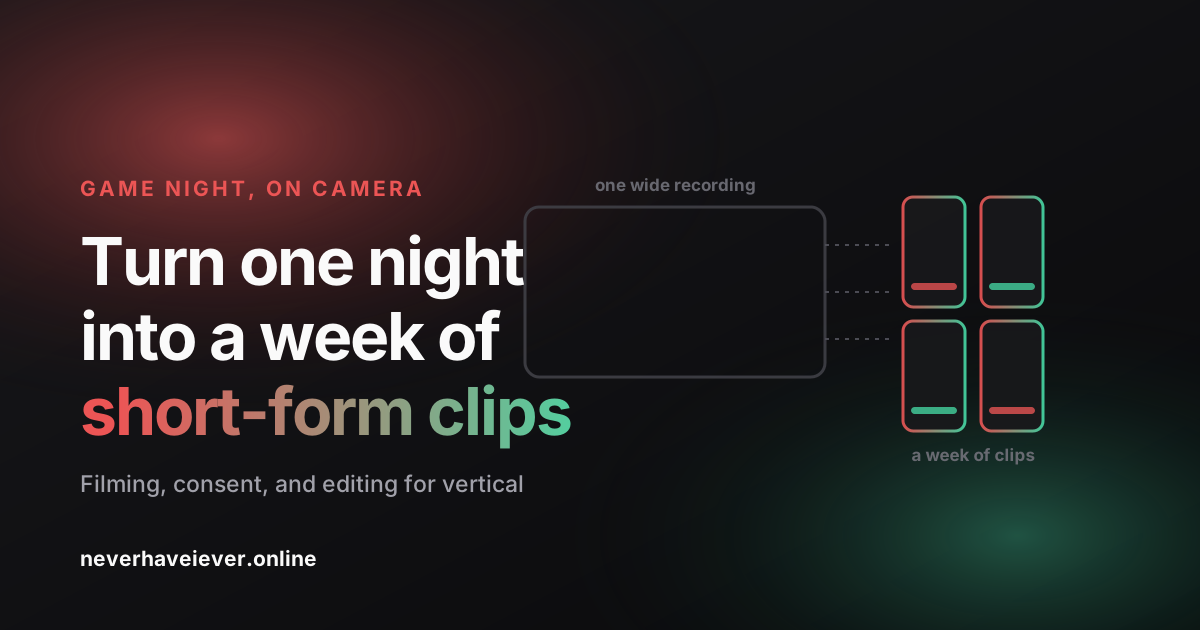
One Game Night, a Week of Content
A good Never Have I Ever session produces more genuinely funny material in forty minutes than most people can script in a month. Real reactions, real confessions, real people talking over each other. That is exactly what short-form video rewards, and most of it gets recorded on someone's phone and then never watched again.
This guide covers how to film a game night properly, the consent rules that keep it fun instead of awkward, and how to get from a long recording to clips people actually watch.
Table of Contents
- Why Game Night Footage Works on Short-Form
- Get Consent First, Properly
- Camera Setup That Takes Two Minutes
- Audio Matters More Than Video
- Playing for the Camera Without Killing the Vibe
- Finding the Moments Worth Posting
- Editing for Vertical
- Posting Without Burning Out
Why Game Night Footage Works on Short-Form
Short-form platforms are ruthless about the first two seconds. Scripted content has to manufacture a hook. Game night gives you one for free: someone's face when a question lands too close to home is a hook that no amount of writing can fake.
It also solves the hardest problem in content creation, which is having something to say. A single session gives you dozens of self-contained moments. Each one already has a beginning, a punchline, and a reaction shot, which is the entire structure of a short-form video.
The other advantage is that the format is legible instantly. Viewers know this game. You do not have to explain the premise, which means you are not spending your first five seconds on setup.
Get Consent First, Properly
This section matters more than the technical ones, so it comes first.
Never Have I Ever produces confessions. That is the whole point of the game, and it is also why publishing the footage carelessly can genuinely damage friendships or worse. Someone admitting something in a living room with five friends has not agreed to say it to the internet.
A few rules that keep this simple:
- Ask before you record, not after. Getting the camera out and asking forgiveness later puts people in a position where saying no feels rude.
- Agree on categories that are off-limits before you start. Work, exes, family, anything legal. Ban them from the question pool rather than trying to edit around them later.
- Give everyone a veto after the fact. Send the clips to the group before posting and let anyone kill anything with no explanation required. Honour it every time, immediately.
- Do not post someone's face without asking, even if the audio is harmless. Some people simply do not want to be findable.
- Be extra careful with anyone not in the room. A story about a friend who is not there and cannot consent should not be published.
If this sounds like it will cost you good clips, it will. It also means people relax and play properly, which produces better material than a table full of people editing themselves in real time.
Camera Setup That Takes Two Minutes
You do not need a production rig. You need to solve three things.
Framing. Put the phone where it can see faces, not the tops of heads. Roughly chest height of a seated person, propped on a stack of books or a small tripod. If you can see everyone's expressions, the framing is done.
Record horizontally, publish vertically. This feels backwards, but a wide frame captures the whole table, and you crop into individual reactions later. If you shoot vertically you get one person and lose every cross-table reaction, which is where most of the comedy is.
Do not move it. A locked-off shot cuts far better than someone wandering around with a phone. Set it once and forget it.
If you have a second phone, put it on the opposite side of the table. Two angles of the same reaction gives you a cut, and cuts hold attention.
Audio Matters More Than Video
Viewers forgive a soft, grainy picture. They will not forgive not being able to hear the punchline.
Phone microphones are optimised for whoever is closest, so a phone at one end of a table will lose whoever is at the other end. Options, cheapest first:
- Move the phone closer to the middle rather than the edge
- Kill the obvious background noise: music down, TV off, extractor fan off
- A cheap lav mic on the loudest talker, or a small USB mic in the centre of the table
Test it before you start. Record thirty seconds, play it back, and check you can hear the quietest person at the table. Fixing this takes two minutes beforehand and is impossible afterwards.
Playing for the Camera Without Killing the Vibe
The temptation is to perform. Resist it, because performed reactions are obvious and dull. A few small habits help without making anyone self-conscious:
- Read the question out loud, clearly. Viewers need it, and it gives every clip a natural opening line.
- Pause for a beat after the reveal. Reactions get talked over. A half-second of silence gives the moment room and gives you a clean cut point.
- Let people finish. Cross-talk is very hard to caption and worse to edit.
- Do not stop to fix mistakes. The mess is the content. You can cut around it.
Play the game you would have played anyway. The camera is a bystander, not a participant.
Finding the Moments Worth Posting
This is where most people quit. You end up with forty-five minutes of footage, you scrub through it twice, and it ends up in a folder you never open.
A structured pass helps. Watch it once, at normal speed, and note timestamps where you laugh or where the table does. Do not evaluate them, just mark them. You will typically get somewhere between fifteen and thirty marks from a decent session, and maybe eight of those are genuinely postable.
What tends to work:
- A question that visibly lands on one specific person
- Someone answering far too fast
- Someone answering far too slowly
- Group reactions, where four people turn at once
- Anything where the story is better than the question
What tends not to work: inside jokes, anything needing context from earlier in the night, and anything where the funny part is who said it rather than what was said.
If scrubbing manually is the part that kills the habit, this is the step worth automating. Shortzly reads the transcript and finds the moments worth clipping, then crops to vertical with face tracking and burns in captions, which turns the boring part of this into a few minutes rather than an evening. Either way, the criteria above are what you are looking for.
Editing for Vertical
Four things separate a clip that gets watched from one that gets scrolled past.
Crop to the person talking. From a wide table shot, that means following the speaker, not sitting on the whole table. A static wide shot on a vertical screen makes everyone tiny.
Captions are mandatory. A large share of short-form viewing happens with the sound off, and game night audio is exactly the kind of overlapping, room-toned audio that needs help. Word-level captions that highlight as they are spoken hold attention better than a static block of text.
Cut the dead air at the front. Start on the question or the reaction. Whatever happened in the ten seconds before does not belong in a thirty-second clip.
Keep it between fifteen and forty seconds. Long enough for setup and punchline, short enough that people finish it. Completion rate is what these platforms actually reward.
Posting Without Burning Out
The mistake is dumping eight clips the day after game night and then having nothing for three weeks. Platforms reward consistency far more than volume.
Space them out. Eight clips at three a week is nearly three weeks of content from one evening. Keep a couple in reserve for weeks when you do not record.
Watch which ones perform and let that guide the next session. If couples questions do well, play more of those. If a particular friend is reliably funny on camera, invite them more often. The footage tells you what your audience wants faster than any planning does.
And do the boring part properly: post at consistent times, reply to comments in the first hour, and use the same handful of hashtags rather than a new set each time.
Play a round first if you need material. Our question categories will give you a session's worth, and the online version works if your friends are not in the same room.